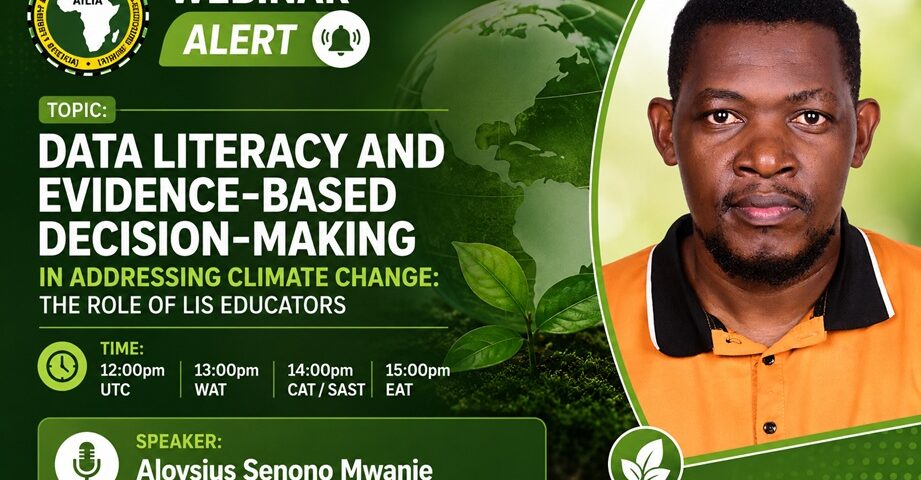
Webinar on Data Literacy and Evidence-Based Decision-Making in Addressing Climate Change: The Role of LIS Educators
Overview
The webinar on Data Literacy and Evidence-Based Decision-Making in Addressing Climate Change: The Role of LIS Educators explores the critical intersection between data competencies and climate action. As climate change increasingly becomes a data-driven global challenge, the ability to access, interpret, evaluate, and communicate data is essential for informed decision-making.
This session highlights the importance of data literacy as a foundational skill for navigating complex climate information and emphasizes the role of evidence-based decision-making in shaping effective policies and sustainable interventions.
Within this context, Library and Information Science (LIS) educators are positioned as key agents in developing these competencies through curriculum design, capacity building, and advocacy for open and ethical data use. The webinar further examines existing gaps in data skills, particularly in developing contexts, and proposes practical strategies for integrating data literacy into LIS education to empower graduates, institutions, and communities to respond effectively to climate change challenges.
In this webinar, the facilitator focuses on how LIS educators can equip learners with knowledge and skills in data access, interpretation, and use to support data-informed decisions to climate-related challenges.
Objectives
By the end of this webinar, participants will be able to:
- Explain the concept of data literacy and its relevance in addressing climate change.
- Describe the importance of evidence-based decision-making in climate change mitigation and adaptation.
- Examine key gaps and challenges in data literacy and data use within LIS education and practice.
- Analyse the role of LIS educators in promoting data literacy and supporting climate-informed decision-making.
- Identify practical strategies for integrating data literacy into LIS curricula and professional training.
Target group
The webinar will bring together a diverse group of participants, including librarians, information professionals, researchers, educators, policymakers, environmental advocates, Data scientists, development partners, and students interested in climate action and sustainable development.
Date: Friday, 5th June, 2026
Time: 12:00 UTC | 13:00 WAT | 14:00 CAT / SAST | 15:00 EAT
Registration
Please click the registration button to sign up for the webinar. Once you register, you will receive reminders and updates about the event.
Speakers

Aloysius Senono Mwanje is a PhD student in the Information Science program at the University at Buffalo (SUNY, Buffalo), specializing in data literacy. His work explores how data can be transformed into actionable knowledge through improved documentation, veracity, and access in complex data environments such as climate science and healthcare systems. He is particularly focused on developing data literacy frameworks that could help data users, including LIS educators, develop competencies in accessing, interpreting, and applying data effectively, thereby advancing data-informed approaches to global challenges such as climate change.
Technical requirements
After registration, reminders will be sent periodically to all participants. The webinar will be hosted on the Zoom Conferencing Platform. Participants who do not already have Zoom on their devices should download, install, and create an account ahead of time (CLICK TO DOWNLOAD).
Participants are encouraged to join at least 15 minutes before the start of the session to allow time to launch the application and test their connection. The speaker will connect using a webcam, and audio and video will be streamed through computer speakers. For the best experience, participants are encouraged to use a headset or earpiece.
Webinar materials
A list of resources and additional information will be shared at the end of the webinar to support deeper engagement with the topic. All registrants will have access to the presentation slides. The webinar recording will be uploaded to the AfLIA YouTube Channel after the event to support continued learning for both attendees and non-attendees. Please note that certificates of participation will not be issued for this webinar.
Enquiries
For further enquiries or assistance related to this webinar, please contact: afliacomm@aflia.net