
CALL FOR ABSTRACTS: 7th AfLIA Conference & 9th African Library Summit AfLIA Conference
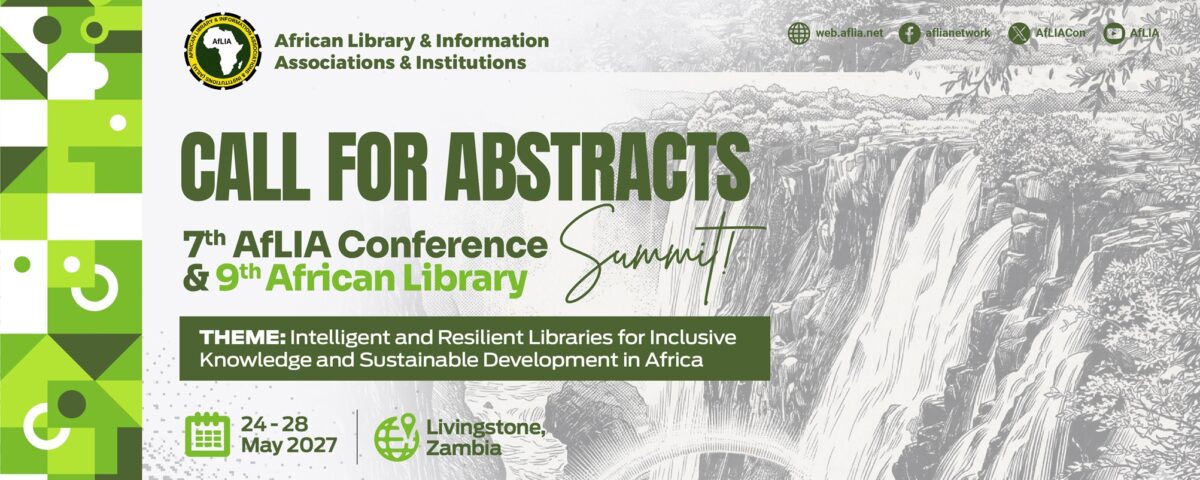
Conference Date: 24th – 28th May, 2027, Livingstone, Zambia
Theme: Intelligent and Resilient Libraries for Inclusive Knowledge and Sustainable Development in Africa
The African Library and Information Associations and Institutions (AfLIA) invites the submission of abstracts for its 2027 biennial Conference, to be held from 24-28 May 2027 in Livingstone, Zambia. It promises to be a landmark gathering of library and information professionals, scholars, researchers, technologists, and policymakers from across the African continent and the global library community. The conference will address the widespread convergence of digital transformation, artificial intelligence, learning, and social equity, and the enduring mission of libraries to serve every community through access to information and the power to learn, be educated, gain knowledge, and function optimally as literate citizens of the community.
This conference will bring evidence and ideas to the table on how African libraries drive development, as well as provide opportunities for all participants to build networks and collectively shape the future of African library and information services. Contributions are welcome from all African countries and Diaspora communities, as well as international partners working in solidarity for the development of the African library sector. Through this conference, AfLIA envisages that African libraries would not remain passive repositories of the past. Instead, they would be moved on the pathway to becoming more intelligent, adaptive, and resilient engines of inclusive development.
Abstracts are invited under the following thematic tracks and sub-themes. Authors may address one primary track or explore intersections between multiple themes.
Theme: Intelligent and Resilient Libraries for Inclusive Knowledge and Sustainable Development in Africa
Subtheme and tracks:
- AI, Data, and Emerging Technologies in African Libraries
- Leveraging AI, analytics, and smart services in library operations,
- Digital tools for metadata, research, and information discovery,
- Ethics and Responsible AI Usage in Libraries.
- Privacy and Governance in AI-driven LIS services
- Resilient Libraries and Adaptive LIS Workforce
- Building resilient Libraries: infrastructure, funding, and climate adaptation
- Librarians of the future: skills, leadership, and adaptive capacity
- Continuing professional development and modernised LIS curricula
- Inclusive Knowledge, Access, and Social Impact
- Ethical documentation, ownership, and governance of indigenous knowledge
- Digital inclusion, multilingualism, and services for marginalised groups
- Preserving and sharing indigenous knowledge and cultural heritage
- Bridging the digital divide in rural and underserved communities
- Libraries as hubs for social transformation, SDGs, and community engagement
- Collaboration, Partnerships, and Policy Frameworks
- Working with non-library stakeholders: education, health, agriculture, industry
- National and regional policy, regulation, and advocacy for LIS development
- Investment in libraries: funding models, public-private partnerships, and innovation labs
- Memory institutions’ collections enhancing national governance, accountability, and development
- Collaboration, Partnerships, and Knowledge Networks
- Libraries, Policies and National Development Agenda
- Innovation in Libraries and Information Services
- Innovation in Learning, Research, and Skills Development
- LIS education reform: modernising curricula for emerging tech and research demands
- Libraries as incubators of digital literacy, research, entrepreneurship, and innovation
- Cross-sector collaborations to enhance impact on African development
- Research-to-policy and research-to-practice pathways
- Open Knowledge, the future of Shared Scholarship
- Open data for evidence-based development policies
- Open educational resources as tools for skills development and lifelong learning
- Open access publishing and research visibility for development impact
- Data governance, privacy, and intellectual property rights in development contexts
Expected Outcomes
It is expected that by the end of the Conference and Summit, participants would have been able to:
✔ Understand how to leverage AI tools ethically for smart information services and library operations,
✔ Know how to bridge the digital divide in rural and underserved communities as well as responsibly drive the documentation, ownership, and governance of indigenous knowledge
✔ Expand their knowledge as pertains to collaborating with non-library stakeholders in education, health, agriculture, industry and other sectors,
✔ Rethink how to advocate for favourable national and regional policies that regulate the LIS sector
✔ Have enhanced capacity in driving Research-to-Policy and Research-to-Practice pathways as well as Libraries as incubators of digital literacy, research, entrepreneurship, and innovation,
✔ Comprehend how libraries can be in the vanguard for the promotion, and adoption of the entire Open Knowledge spectrum for skills development, lifelong learning, African research interoperability and visibility for sustainable development, and
✔ Be equipped to envision libraries of the future and the needed skills for the 21st century library professionals.
Important Dates (Deadlines)
- Papers
Submission of Abstracts for papers – 15th June 2026
Notification of Acceptance/Rejection – 20th July 2026
Submission of full papers – 26th October 2026
Submission of presentation slides (PowerPoint) – 27th December 2026
- Posters
Submission of description for Posters – 25th July, 2026
Notification of Acceptance/Rejection – 27th August, 2026
Submission of the representation (picture) of full poster – 27th December 2026
- Ignite Talks
Submission of description for Ignite Talks – 9th November, 2026
Notification of Acceptance/Rejection – 11th December, 2026
Submission of presentation slides (PowerPoint) – 27th December 2026
Submission Guidelines
Plagiarism and AI Check
Acknowledgement of other people’s intellectual work is a core regulation in research. It is an intellectual criminal offence to take credit for another person’s work. AfLIA expects all library professionals and presenters to fully acknowledge all sources quoted and images used in their presentations. Plagiarised works will not be accepted and may incur penalties. Ethical use of AI is advised. Authors are encouraged to declare and duly reference AI-generated content.
- Papers
a. Requirements and Format
Proposals must address the theme and sub-themes and could be written in English, French, or Portuguese. It must be an original work of the speaker(s) and should include:
- Title of proposed paper
- Name(s) of speaker(s)
- Official Title of speaker(s) or Professional role(s)
- Speaker’s institutional affiliation, if any
- Speaker(s) e-mail address, telephone/fax numbers
- Abstract of the proposed paper
- Short professional profile (five lines) of speaker(s)
Completed papers (10 -12 pages) should be scholarly, organized with clear logical narrative flow of ideas, arguments and points, proof-read and copy edited before submission for review.
b. Abstract
- Identify the area(s) of interest in the theme and subthemes/tracks of the AfLIA conference. Please have a clear understanding of the chosen area(s). This will assist you to think and research coherently with the appropriate keywords for knowledge and information on the area(s).
- The abstract should be a minimum of 350 words and should not exceed 500 words.
- The abstract should not make references to other works.
- The main constituents of the abstract should not have been presented in any other conference or previously published online or offline.
- The abstract should be made up of the objectives/scope of the paper proposal; methods and procedures/process of investigation/research where applicable; results; observations; conclusions; and recommendations.
- Please ensure the inclusion of at least four keywords.
c. Technical details
- Only Microsoft Word documents will be accepted for review. Papers in other formats will not be accepted.
- Use 12pt, Times New Roman font.
- Maintain 1.5 line spacing within paragraphs and 2.0 spacing between paragraphs.
- First line of each new paragraph should be indented.
- Please do not insert headers or footers.
- Ensure that all sources referred to or quoted in the body of the paper are listed in the reference section and vice versa.
d. PowerPoint presentation
AfLIA expects PowerPoint slides that highlight key points with appropriate visuals and are not overly crowded with words.
- Each paper is expected to have 12 -16 slides maximum.
- Slides should be done in Baskerville Old Face 36pt.
- No slide should have more than 50 words.
- Copied visuals must be attributed in small print or in a slide at the end of the presentation
2. Posters
There will be a Poster session at the Conference/Summit. Poster Proposals must address the main theme or sub-themes and could be written in English, French or Portuguese. To submit a proposal to participate in the Poster Session, please provide the following information:
- Presenter’s name, institution and email
- Poster title
- Poster description (limit 250 words)
- Goal(s)
- Target audience
- Theme of Poster
The topic could be described on a printed poster or by photographs, graphics and pieces of text that are attached to graphics or photographs. Poster presenters are expected to be present to explain their posters and to hand out leaflets, or other information materials, they have available for viewers.
Each presenter can therefore present only ONE poster.
TIPS FOR A GOOD POSTER
- Present new ideas or present an application of technology;
- Have a clear library relevance or perspective geared towards either of the themes;
- Describe a project thatis ongoing or near completion, not one that is yet to start.
3. Ignite Talks
Opportunities will be given for participants to share short, sharp, passionate, insightful, inspiring 6 minutes Ignite Talks on the ‘what, how, why and when’ as pertains to the theme and subthemes of the conference. These Talks must be accompanied with related, meaningful and impactful visuals (PowerPoint, Spark Adobe, Canva or video clips). To submit a proposal to present an Ignite Talk, please provide the following information:
- Presenter’s name, institution and email
- Ignite Talk title
- The subtheme/track it addresses
- Ignite Talk description (limit 170 words)
- A short video (not more than 10MB) of the presentation (optional)
Furthermore…
The full and final presentation must not exceed 4 slides in timed automatic sequence. Links to videos might be embedded in the slides, but the entire presentation must not go beyond 6 minutes. Endeavour for each slide to have meaningful pictorial content.
4. Submission of Proposals
Please email your proposal and all other enquiries to programofficer@aflia.net with a copy to secretariat@aflia.net
5. Changes, Cancellations, Withdrawals
Submission of abstracts for papers and descriptions for posters/Ignite Talks is viewed as a commitment to register and be present at the 7th AfLIA conference & 9th Africa Library Summit that will be held in Livingstone, Zambia from 24th – 28th May, 2027. Nevertheless, if situations arise that prevent the author(s) from being present, it is incumbent on such person(s) to make alternative arrangements for the presentation and communicate such in writing to the AfLIA Secretariat secretariat@aflia.net ; with a copy to programofficer@aflia.net at least 6 weeks before the conference.