The African Librarians Week 2026
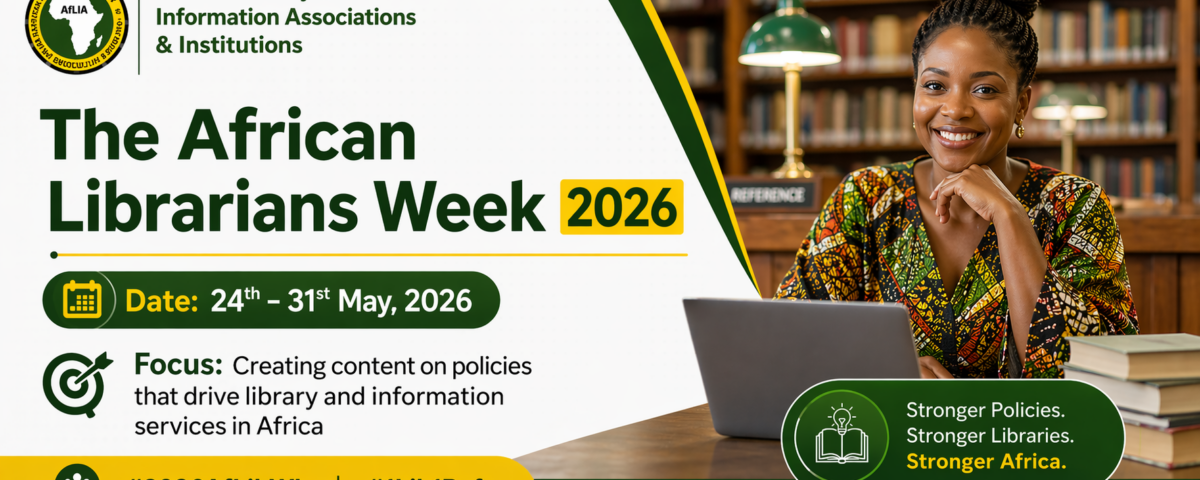
As we celebrate 2026 African Librarians Week (24th – 31st May, 2026) as an integral part of the global 1Lib1Ref campaign, the African Library sector is pivoting to ‘Policies that drive library and information services in Africa’ as an area that has not received in-depth attention in Wikipedia.
Libraries in Africa operate within a multi-layered policy environment. The policies shape how libraries of different types function, deliver information services, and contribute to development. These include regional policies that strategically direct and shape national guidelines such as the AU 2063 Agenda, the AU Science, Technology and Innovation Strategy for Africa (STISA-2024), the AU African Data Policy and the AU AI Strategy.
However, libraries, as a critical knowledge infrastructure for Africa’s transformation, are mostly affected by national policies, which vary widely. These national policies include National Library Acts, copyright and intellectual property laws, national educational policies, national data protection laws, ICT and Digital Economy Policies, language policies (which may influence multilingual access to information resources), rural development policies (which may determine where and how libraries are sited and operated in rural areas), gender and inclusion policies (which may be liberal or conservative based on culture and religious inclinations) and national AI strategies/guidelines. These policies determine whether and how libraries can lend, digitize, provide internet access, or support research openly, as well as the availability of infrastructure and funding levels.
As the influence of Open Access and the entire open knowledge ecosystem continues to grow, operations in academic and research libraries are guided by institutional policies on Open Access, Open Educational Resources, and Research Data Management. These policies guide library operations as they pertain to institutional repositories, knowledge dissemination, and the visibility of knowledge outputs from their various parent institutions.
Library operations in Africa are also guided by internal policies on collection development, user access policy, and data management policy, amongst others.
Starting from 2020, AfLibWk has been working to:
- raise awareness about the role of African libraries and librarians in the 21st century knowledge ecosystem,
- lead African librarians to sharpen their digital skills through collaborative editing of articles and items on Wikipedia, Wikidata and other Wikimedia platforms as may be chosen,
- address gaps about Africa on Wikipedia, Wikidata and other Wikimedia platforms by adding reliable citations thus ensuring that accurate and current information about Africa is available to a global audience
The #2026AfLibWk is expected to be more robust, engaging and productive. AfLIA will create country hubs with Champions for this year’s event. African librarians will work collaboratively within their country hubs to;
- Identify in-country policies/guidelines and laws that affect access to information (for example, there may be an article in Wikipedia on a country’s Copyright agency, but none for the Copyright law itself!).
- Create articles on these policies where they do not already exist on Wikipedia under the guidance of AfLIA
- Identify article stubs in these policy areas and significantly add the missing information, e.g. https://en.wikipedia.org/wiki/Copyright_law_of_Cameroon
- Add citations to articles where they already exist in the above-mentioned areas
AfLIA therefore invite all African library professionals to participate in the 2026 African Librarians Week by joining us for activities on the following days;
| No. | Activity | Date | Resource person(s) |
| 1 | In-country mobilization of library and information professionals for #2026AfLibWk | 24th April – 23rd May, 2026 | All country champions |
| 2 | TRAINING SESSION 1: Basic introduction to Wikipedia for librarians (including the five pillars of Wikipedia etc.) | 30th April, 2026 | Jeremiah Ugwulebo, PhD Head of Special Resources Collection & Circulation Librarian, Donald Ekong Library, University of Port Harcourt. |
| 3 | TRAINING SESSION 2: Writing new articles in Wikipedia using templates of featured articles [Part 1] | 5th May, 2026 | Ramatu A. Haliru Librarian, Founder, Wikimedia User Group Nigeria – Kaduna Network |
| TRAINING SESSION 3: Writing new articles in Wikipedia using templates of featured articles [Part 2] | 7th May, 2026 | Jesse Asiedu-Akrofi, Open Foundation West Africa | |
| 4 | WEBINAR: Promoting reading and learning in Libraries through the Wikipedia App | 12th May, 2026 | Silvia Gutiérrez, Senior Program Officer, Libraries, WMF |
| 5 | In-country refresher trainings, task allocation (division of labor, involving the assignment of article sections to editors for research and data gathering), and drafting of Wikipedia articles. | 12th May – 23rd May, 2026 | All country champions & AfLIA Secretariat |
| 6 | 2026 African Librarians Week | 24th – 31st May, 2026 | All AfLibWk Contributors |
Ensure that your country is not left behind as an African Librarian! Click here to register to be a part of this epoch making #2026AfLibWk